Digital Libraries and Rural Reach: AI for Inclusive Learning
Access to knowledge goes beyond books. It is about connections. Digital libraries are bridges that link communities to ideas, skills, and opportunities. In rural areas of India, and across the globe, access often depends on mobile platforms and television. With massive penetration of TV and mobile, AI can make knowledge accessible to every home.
INDUSTRY INSIGHTSAI SOFTWARE DEVELOPMENTAI TRENDS2026
Prajim Mannemplavan
2/4/20263 min read
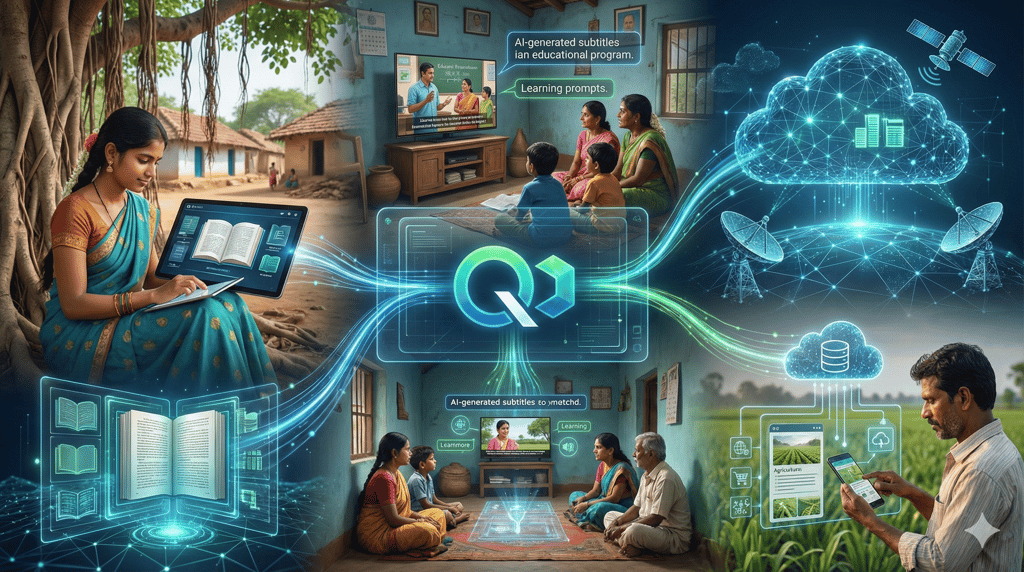
Access to knowledge goes beyond books. It is about connections. Digital libraries are bridges that link communities to ideas, skills, and opportunities. In rural areas of India, and across the globe, access often depends on mobile platforms and television. With massive penetration of TV and mobile, AI can make knowledge accessible to every home.
Why Digital Libraries Matter
A child in Kerala watches a folk dance on television. With an AI-powered app, she learns its history, practices steps, and connects with peers. In Zambia, students use mobile phones to access archives of local crafts. In the Maldives, television programs paired with AI apps bring lessons into remote islands. These are not distant dreams. They are happening.
Digital libraries matter because they:
Build bridges between rural and urban learners.
Preserve culture while promoting education.
Empower communities to share and grow together.
Here’s a guiding thought: What happens when every learner, regardless of location, has access to the same knowledge?
The Role of Technology
AI is not alone. It works with AR, VR, IoT, and telecom connectivity. Together, they create immersive, practice-oriented learning.
AR and VR bring heritage alive. Imagine weaving techniques demonstrated in 3D, accessible on a phone. Improve access to vast libraries of historical data.
IoT ensures reach. Devices connect classrooms in remote villages to global archives.
Telecom connectivity makes mobile platforms the gateway to digital libraries.
These technologies make learning interactive. They turn passive watching into active participation.
Culture and Heritage is Knowledge
Learning isn’t about textbooks alone. Learning is a human pursuit. Handicrafts, weaving, speech, listening, dancing, and folk arts are forms of knowledge. AI can preserve and teach them under the careful eye of experts.
Tribal communities in Kerala become part of the digital journey. Their crafts are documented. Their voices amplified.
In Nairobi, oral storytelling traditions are archived with AI.
In Calicut, fishing techniques are recorded and shared globally.
Guiding question: How do we treat cultural knowledge as equal to academic knowledge?
The answer is clear, communities thrive, and learners see themselves reflected in their education.
Educators and Skill Transfer
Educators, professionals, and policymakers transfer skills from academia and industry to youth. With bodies like CII and AICTE in India maintaining facilities to offer technical training and complemented by the digital skills mission of the government, AI is a prime focus.
AI enhances this transfer of experience.
Professors share research through digital platforms.
Industrialists document techniques for future generations.
Policymakers design inclusive frameworks that reach rural learners.
AI is not about replacing teachers. AI implementation is about amplifying their role as guides in making learning flexible, inclusive, and practical. A child needs someone to bounce ideas back, gain advice, celebrate wins, and be inspired. Educators and mentors are central to this journey, just as are peers.
Environmental Stewardship
Digital libraries also carry lessons of sustainability. Methods like Miyawaki forests, recently popularized in India, show how communities reclaim green spaces. Learn more.
AI can track growth, raise awareness in schools, and inspire projects in colleges and employment councils.
Famous curricula like IB and CIE emphasize sustainability.
Researchers such as Sugata Mitra, with his “Hole in the Wall” experiment, proved how self-learning thrives when access is democratized.
Educators like Maria Montessori showed how values enrich learning systems.
These examples remind us: technology is powerful, but it is teachers, communities, and shared responsibility that make it human.
Let’s Reflect
Consider this:
A group of students in Jaipur experiment with drones through their school’s digital library. They begin by learning the basics of aerodynamics and coding flight paths. Soon, they use AI-powered simulations to test how drones can deliver medicines to nearby villages.
Peers in Nairobi join the project virtually, sharing insights from local drone programs used for agriculture.
Together, they refine designs, solve logistical challenges, and create a model that blends innovation with community service. The solution is implemented to combat malaria in western Kenya. Learn more.
Meanwhile,
A group of learners in Mysore accesses archives of folk music. They remix traditions with modern beats, creating new art forms. See more at the Folklore Museum of Mysore.
Here’s what to ask?
How do we design systems that make learning central to building communities?
How do we ensure every learner feels part of this journey?
How do we balance technology with human agency?
It’s About Time for AI
Digital libraries are a practical need. They come from understanding, listening, testing, and adapting. When AI meets culture, heritage, and education, the result is a smarter system that amplifies existing systems.
Educators remain at the core. Lesson delivery, guidance, and support are anchors. Technology provides the framework, where teachers and peers breathe life into it. Together, we create learning journeys that are sustainable, inclusive, and deeply human.